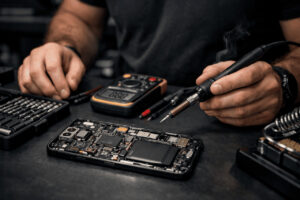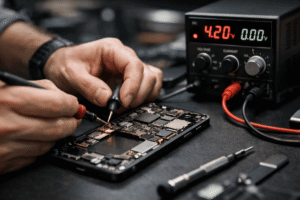

Modern smartphones are powerful, compact, and highly complex. Inside every Android phone or iPhone, there are hundreds of tiny electronic components packed tightly on multilayer PCBs. For today’s mobile phone repair work, especially motherboard and chip-level repairs, working with the naked eye is no longer practical. This is where a good microscope becomes one of the most important tools in a mobile phone repair shop.
In India, mobile phone repairing has evolved rapidly. Earlier, most work involved screen replacement, charging ports, or batteries. Now, customers expect motherboard-level solutions because replacing a phone is expensive. As a result, technicians increasingly deal with SMD components, eMMC, BGA ICs, reballing ICs, fine solder joints, and micro tracks. A microscope is no longer optional; it is essential.
This guide explains everything you need to know before buying a microscope for mobile phone repair in India. It is written from a practical technician’s point of view, using real repair scenarios, simple language, and clear explanations.
Why a Microscope Is Essential for Mobile Phone Repair
A microscope helps you see what your eyes cannot. Many faults in smartphones occur at a microscopic level. Examples include:
- Cracked solder joints under ICs
- Burnt or missing SMD capacitors
- Short circuits between tiny pads
- Broken tracks hidden under chips
- BGA solder balls of an IC
A good soldering iron is also essential for smartphone diagnostics — Here are the best soldering irons for mobile repairing in India
Without proper magnification, these issues are easy to miss. A microscope allows you to:
- Inspect motherboard damage clearly
- Perform precise soldering and desoldering
- Reball and align BGA chips accurately
- Reduce repair mistakes and callbacks
In short, a microscope improves accuracy, confidence, and repair success rate.
This Microscope Buying Guide is Useful for
- Beginners learning mobile repairing
- Local repair shop owners upgrading tools
- Technicians doing Android and iPhone motherboard work
The recommendations are based on actual shop usage in Indian conditions, not just product brochures.
Types of Microscopes Used in Mobile Phone Repair
Different microscopes are available in the Indian market. Understanding their differences helps you avoid wasting money.
1. Trinocular Stereo Microscope (Most Recommended)
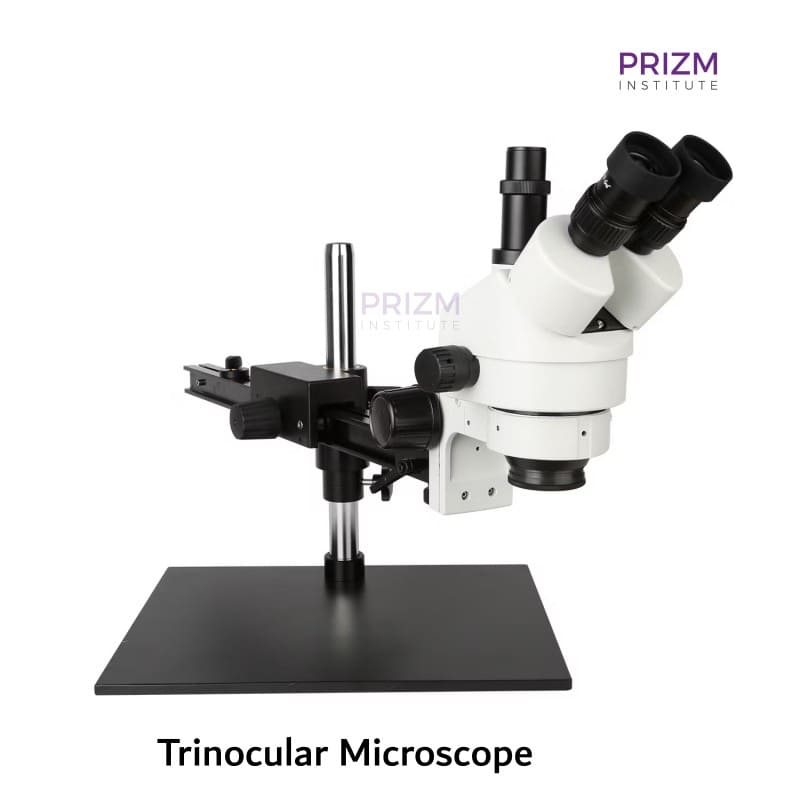
This is the most widely used microscope in professional mobile repair labs.
Why it is preferred:
- True 3D depth perception
- Comfortable for long working hours
- Extra port to attach a camera
- Ideal for soldering, jumper work, and IC handling
A trinocular microscope is suitable for both Android and iPhone chip-level repairs and is future-proof for training or video recording.
2. Binocular Microscope
A binocular microscope has two eyepieces but no camera port.
Best for:
- Beginners
- Budget-conscious technicians
- Learning basic motherboard inspection
Limitations:
- Cannot connect a camera directly
- Less flexible for teaching or documentation
It is still a good starting point if you plan to upgrade later.
3. Digital Microscope (USB / HDMI)
Digital microscopes are commonly sold online and are popular because of their low price.
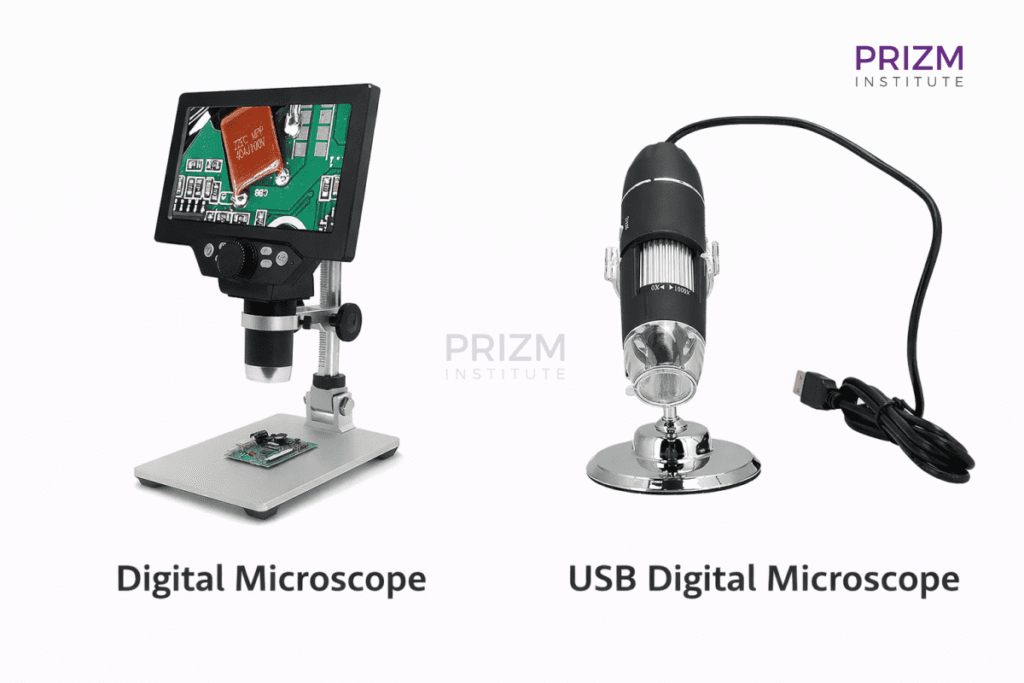
Advantages:
- Easy to connect to a screen
- Useful for inspection and demonstrations
- Good for training videos
Limitations:
- Poor depth perception
- Not ideal for precise soldering
- Slight delay on screen can affect hand movement
Most technicians buy digital microscopes to save money but it is not recommeded for chip-level motherboard repairing and eMMC level mobile repairing.
Key Specifications to Check Before Buying a Microscope
Many microscopes look similar but perform very differently. Focus on these specifications.
Magnification Range
For mobile phone repair, 7X to 45X magnification is ideal.
- Low zoom (7X–10X) is useful for overall board inspection
- Medium zoom (20X–30X) is perfect for soldering
- High zoom (40X–45X) helps inspect fine joints
Be careful with products claiming extremely high magnification like 1000X. In real electronics repair, clarity matters more than numbers.
Working Distance
Working distance is the space between the microscope lens and the motherboard.
A good working distance:
- Allows space for hot air rework
- Makes soldering comfortable
- Reduces hand obstruction
Short working distance microscopes are frustrating during real repair work.
Optical Quality
Good microscopes use glass optics, not plastic lenses.
Better optics mean:
- Clear image
- Less eye strain
- Better color accuracy
- Comfortable long-hour usage
In Indian mobile repairing shops, technicians often work 8-10 hours a day. Eye comfort is very important.
Field of View and Depth of Field
- A wider field of view helps you see more of the board at once
- Good depth of field keeps components in focus even when height varies
These features make soldering safer and faster.
Connecting a Camera to a Microscope for Better Clarity
Connecting a camera to a microscope can significantly improve the repair experience. A trinocular microscope allows you to attach a dedicated microscope camera through its third port.
When a camera is connected:
- The image appears on a larger screen or monitor
- Small details become easier to see
- Fine solder joints and BGA pads are clearer
- Eye strain is reduced because you are not always using eyepieces
A good camera does not increase optical magnification, but it enhances visibility and comfort. It also helps in:
- Recording repair videos
- Taking high resolution images
- Showing customers the fault clearly
In many Indian repair shops, technicians use HDMI cameras connected to LED monitors or TVs because they are affordable and easy to set up.
Microscope Stand and Base Stability
The stand is often ignored but is extremely important.
Common Stand Types in India
- Single arm stand
- Double boom stand
- Heavy base stand
A stable stand prevents vibration during soldering. Lightweight bases are common in cheaper models and can cause shaky images, especially in small shops with uneven tables.
A heavy metal base with smooth movement is always a better long-term choice.
Ring Light and Illumination Quality
Good lighting is essential for electronics repair.
A quality LED ring light provides:
- Uniform illumination
- Shadow-free view
- Adjustable brightness
In India, voltage fluctuations are common. Cheap ring lights often fail early or flicker. Always choose microscopes with reliable LED lighting and proper power adapters.
Features Mobile Repair Technicians Should Prioritize
Before buying, check for these practical features:
- Smooth zoom mechanism
- Comfortable rubber eyepieces
- Anti-static safe build
- Availability of spare parts
- Local service and warranty support
These details matter more than brand names.
Common Mistakes to Avoid When Buying a Microscope
Many technicians regret their purchase because of these mistakes:
- Buying very cheap microscopes without checking optics
- Falling for high magnification marketing claims
- Ignoring after-sales support
- Choosing digital-only microscopes for soldering work
A microscope is a long-term investment. Saving a little money upfront can cost more later.
Price Range of Microscopes in India
Prices vary depending on build quality and features.
- Entry-level digital microscopes: Suitable for beginners: Price is around Rs 400 – Rs 600
- Mid-range microscopes: Best balance of price and performance Rs 5000 – Rs 12,000
- Professional setups: Used by advanced technicians and institutes Rs 17,000+ for microscope, Rs 7,500+ for camera, and Rs 6,000+ for LCD
Instead of focusing only on price, think about value for money and upgrade options.
4 Popular and Best-Selling Microscopes for Mobile Phone Repair in India
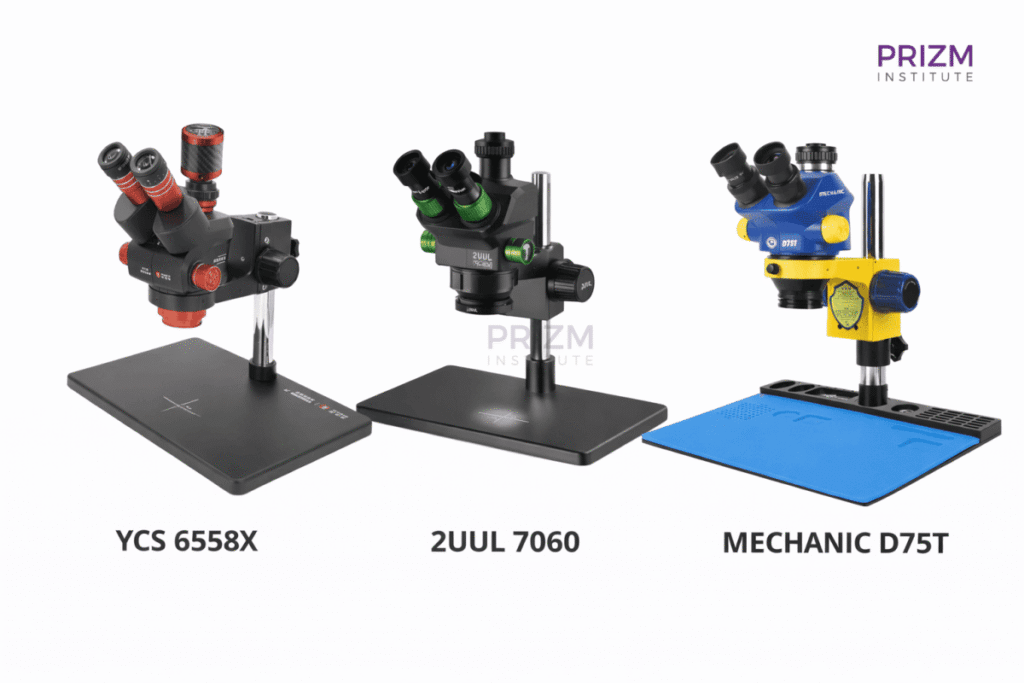
Below are some commonly used microscopes in Indian repair labs. Prices are approximate and may vary by seller.
1. Mechanic Trinocular Microscope D75t
Price: ₹13,500 – ₹14,000 (₹11,500 without camera connection)
Details:
Very popular among mobile technicians. 7X to 50X magnification, Good optical clarity, stable stand, and camera support. Suitable for chip-level repair and training use.
2. YCS 6558x Microscope
Price: ₹15,000 – ₹16,000
Details:
Known for decent build quality and smooth zoom. Widely available in Indian markets. 58X Magnification. One of the best option for professional repair shops.
3. 2uul 7060 Microscope
Price: ₹17,500 – ₹18,500
Details:
Best for eMMC and chip-level repair work. 60X Magnification. Good optics for all types of motherboard-level repair work
4. RF4 RF7050 Microscope
Price: ₹15,500 – ₹16,500
Details:
Popular for cell phone repair among technicians. Useful as an effective microscope, ideal for precision chip-level repair work.
Other than the microscopes mentioned above, Sunshine, Relife and RF4 are also popular brands in India that make good-quality microscopes for mobile repairing. If you are planning to buy tools, here is a comprehensive list of mobile repairing tools with uses and prices that every technician should have.
Maintenance and Care Tips in Indian Conditions
India’s environment can affect tools if not maintained properly.
Follow these tips:
- Cover the microscope when not in use
- Clean lenses with proper lens paper
- Avoid moisture during monsoon
- Use voltage stabilizers if needed
Good care can make a microscope last for many years.
Frequently Asked Questions
Which microscope is best for mobile repairing in India?
A trinocular stereo microscope with 7X–45X zoom is best for most technicians.
Is a trinocular microscope necessary for beginners?
Not necessary, but it is a good investment if you plan to expand and grow work.
Can a digital microscope replace an optical one?
No. Digital microscopes are helpful, but optical microscopes are better for adbvanced level work.
What magnification is best for iPhone motherboard repair?
Around 20X–30X is ideal for most iPhone chip-level repairs.
How long does a good microscope last?
With proper care, a quality microscope can last many years in a repair shop.
You can join mobile repairing course at Prizm Institute in Mumbai, if you wish to learn all skills and techniques related to repairing smartphones and tablets.
Final Thoughts
A microscope is one of the most important tools in a mobile phone repair setup. It directly affects repair quality, speed, and confidence. For Indian technicians, choosing the right microscope means balancing optical quality, comfort, durability, and local support.
Instead of buying the cheapest option, focus on clarity, stability, and long-term usability. A good microscope not only improves your work but also protects your eyes and reputation as a technician.