
Whenever you commence to repair any device or a gadget, it is utmost important that you follow a few necessary safety guidelines. This is to be taken into consideration so that you do not become prey to any sort of accident due to your carelessness or rough handling of the job. This also sends a message to other people about how disciplined and well organized you are.
Just remember that it is the law of the trade that no person wants to give his or her precious device or gadget for repairs to someone who is disorganized or has a shoddy style of working. Neatness in your job is a sure sign for attraction of new customers who are willing to leave their expensive handsets in safe hands. Follow the under-mentioned rules and see the sea of change it brings to your regular business.
Safety Guidelines and Instructions For Cell Phone Repair
1. A Clean Work Station
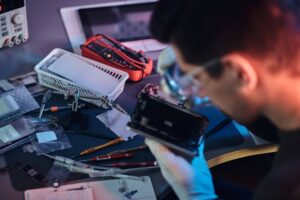
Agreed that cell phone repairs is a mind-eating and stressful job, it does not mean that you be careless and keep your work station disorganized. Keep all your regular tools within your arms reach and at appropriate place so that with time you get so well versed with the setting that when need arises for a particular tool, your hand reaches out to it on its own and you do not even have to see with your eyes to locate it.
Since the condition and settings of a work station reflects on the character and habits of a person, it is indeed necessary that you keep your workplace spic and span and never leave it cluttered.
If you wish to learn how to repair phones professionally, you can join our mobile repairing course and become a technician in 3 months.
Updated Note
Today, clean workstations are even more important because phones have become slimmer, more sensitive, and include complex parts like foldable displays and multiple cameras. A tidy place reduces dust, which can damage these newer components.
2. Use Correct Tools
To work as a professional technician, it is a must that you should have all the tools that are normally required. Additionally, you should have all the specialized tools for the particular device you want to fix. Here is a complete list of all mobile repairing tools with prices that a professional technician should have.
Never make do with substitutes even if you are well in hurry. For instance, you will need a Phillips screwdriver to open a screw with a Phillips (plus) head. Do not attempt to open it with a slotted (minus) screwdriver because you will definitely damage the head of the screw.
Also do not attempt to separate the front or back cover of a handset with your thumb’s nail. Instead use a plastic mobile phone opener because attempting to do the former way will hurt your thumb and this may stop you from carrying on your work for a long time because of the injury.
Having all relevant as well as specialized tools in your workstation is bound to send a strong message to your customers about how choosy and particular you are about your work.
Updated Note
Modern smartphones require tri-point, pentalobe, and Torx screwdrivers. Foldable phones also need special opening tools. Using proper equipment protects both the phone and your reputation.
Read 20 Killer Tips To Be Successful In Cell Phone Repair Business
3. ESD Protection
ESD (Electro Static Discharge) is the sudden flow of electricity between two electrically charged objects caused by any contact between them. The intensity of this current can never be said as it differs from one device to another. It all depends on a person as well so as how much one can absorb it. In some cases it might give you a tingling sensation or even stun you or maybe it is possible that you may not feel it at all.
To summarize all this into one, it is best you use protection for ESD. For ESD protection, you need to use an anti static wrist strap. The anti static wrist strap is to ground any static buildup in the human body. Additionally, you can also use anti static gloves and an anti static mat and ESD safe tools.
Read What is Electrostatic Discharge
Note: I know many (most) technicians worldwide do not use ESD protection! But it is always better to be on a safer side. If you don’t use protection, make sure you touch any metallic part before touching the motherboard. Also it is better if you do not touch any component on the motherboard.
Note: ESD protection is not required for your safety. It is for the safety of the electronic components on the motherboard.

Updated Note
Newer chipsets and high-density motherboards used in 5G phones, gaming phones, and flagship devices are far more sensitive to static discharge. Even a tiny spark can damage display ICs or charging ICs. Experts recommend basic ESD control for long-term reliability.
4. Accumulate All Small Parts into a Tray
Whenever you disassemble any handset, always make it a point that you gather all the detached parts in a separate tray (or container) so that you do not have to remember and look for the parts when you reassemble the handset. This way you will not leave out any part to be reassembled and this will also keep you informed about all the screws you have replaced and have not left out any of them.
Some customers are very much particular about these small things and they may get displeased if you leave out any of these screws. Keeping all the parts into one tray will also save you a lot of time which is bound to be wasted if you do not follow this rule.
Updated Note
Magnetic screw mats and labelled trays are now widely used in repair labs. They help you track parts for different models and prevent mix-ups when handling multiple devices.
5. Take Care of Delicate Parts
Most of the parts in smartphones are delicate. Hence it is a must that care has to be taken while disassembling these delicate devices. Any attempt to forcefully remove a part can damage the part or the motherboard to an irreparable situation.
While handling the LCD, make sure you do not have a sharp metallic object in your hand which might cause an ugly scratch on the screen or may even break it.
Updated Note
Modern AMOLED displays, punch-hole cameras, and in-display fingerprint sensors are extremely sensitive. A slight bend or pressure can damage them. Battery swelling has also become more common, so always inspect the battery before proceeding.
6. Care While Using Heating Equipment
All equipments such as soldering iron, rework station, hot air gun, etc., which are used manually while doing repairs have to be used with utmost caution so that the user does not get scalded or burnt by them. A split second of distraction can cause an accident. So be very much alert while using these tools and have your total concentration into the job.
Also take extra precaution when you have any highly inflammable liquid such as IPA at hand as this may cause fire if this comes in contact with any of these heating equipments.
Updated Note
Newer smartphones use stronger adhesives, so technicians rely heavily on controlled heating. Experts recommend temperature-controlled heat pads instead of random hot air, as they reduce risk to the battery and motherboard.
7. Take Care of Customer’s Data
When you perform a factory reset or reinstall the operating system in a phone, all the data stored in it is compulsorily deleted. The data may be very important for some customers, so it is best advised that you inform the customer before doing it.
Read How To Start A Cell Phone Repair Business From Home
Updated Note
Always ask for written consent before wiping data. With today’s advanced security features like Face ID, biometric locks, and cloud backups, transparency builds strong trust.
Every Day Is Safety Day,
Safety Has No Holiday!
Additional Modern Safety Tips (2026)
8. Handle Water-Damaged Phones Safely
Water-damaged phones often have corrosion and short circuits. Dry the device completely before connecting any power source. Use ultrasonic cleaners only when needed and avoid switching on the phone immediately.
9. Be Careful with High-Capacity Batteries
Modern phones use high-density lithium batteries.
Avoid bending, piercing, or applying excess heat. A swollen battery must be replaced immediately with proper protection gloves.
10. Use Proper Lighting and Magnification
Smartphones now have tiny SMD components.
Use LED lamps, microscopes, or at least a magnifying glass for accuracy.
11. Keep Software Tools Updated
Today many repairs require software-level work like:
• IMEI issues
• Network calibration
• Firmware flashing
• FRP unlock (with permission)
Use only legal and authentic tools to avoid errors and protect customer data.
If you feel any safety instruction is left out, please let us know.
Please share these important safety precautions among your friends.