
Introduction
Mobile phone repair has changed a lot over the years. Modern smartphones are compact, powerful, and sensitive to even small electrical mistakes. Whether you are repairing an Android phone or an iPhone, stable and controlled power is critical during testing and diagnosis.
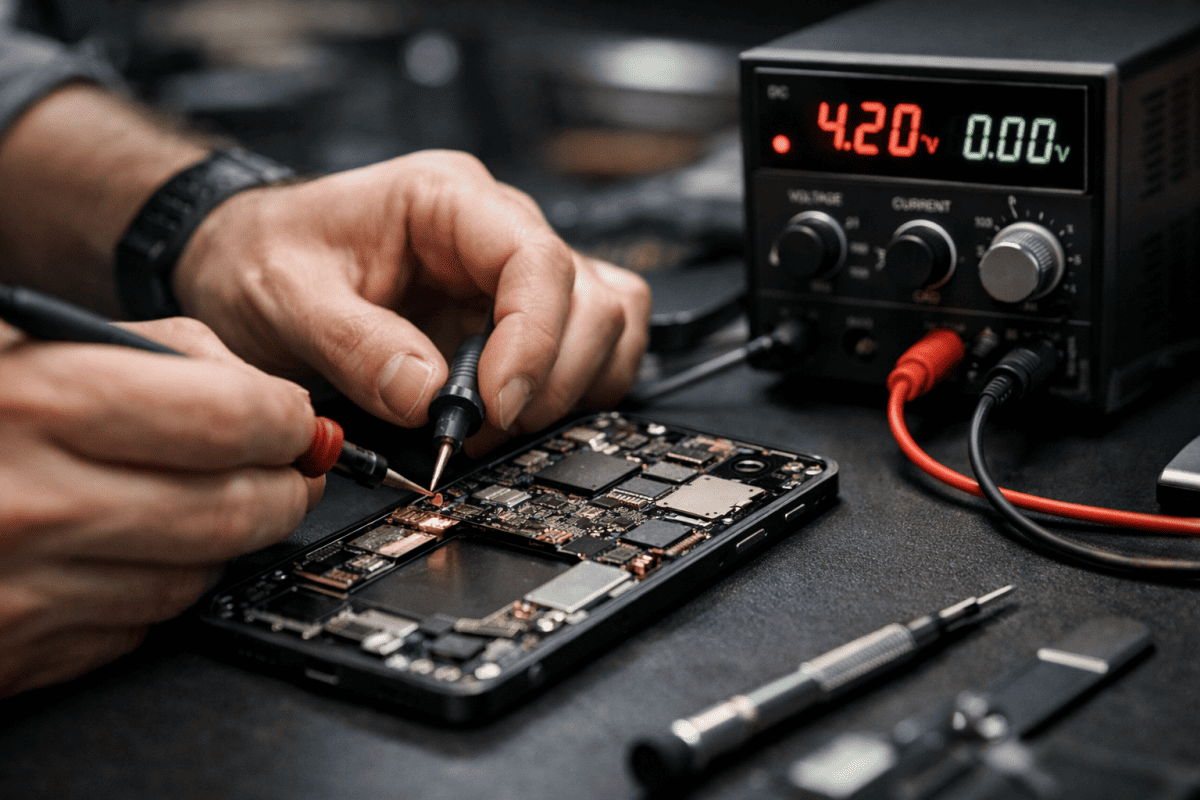
This is where a DC power supply machine becomes one of the most important tools on a mobile repair workbench. It allows technicians to power a phone directly, test faulty devices, identify short circuits, and safely diagnose motherboard issues without relying on the battery.
If you are a beginner, choosing the right DC power supply can feel confusing. If you are already repairing phones, upgrading to a better unit can improve speed, safety, and accuracy.
This article explains everything clearly and then reviews the top 5 best DC power supply machines for mobile phone repair, based on real-world use, reliability, and practical features.
What Is a DC Power Supply Machine?
A DC power supply machine is a bench device that converts AC electricity from the wall socket into DC electricity. In mobile phone repair, it is mainly used to power smartphones directly through battery terminals or test points.
Why batteries are not enough
Smartphone batteries:
- Can be faulty or completely dead
- Do not show current consumption clearly
- Cannot help identify short circuits
Learn how a regulated DC power supply works. It is essential for safe electronics troubleshooting, as it allows precise voltage control and current limiting during device testing.
A DC power supply is also commonly referred to by technicians as battery eleminator and battery booster and battery charger and somtimes using informal or market-level names, such as ‘jhatka machine’ but these are usually of 1 Ampere output and do not help in short circuit detection and motherboard fault detection.
A DC power supply solves these problems by giving you full control over voltage and current. Along with a DC Supply, you need a complete mobile phone repair toolkit to perform professional mobile phone repairs efficiently and safely.
Why a DC Power Supply Is Essential for Mobile Phone Repair
From real repair experience, a DC power supply helps in several critical situations:
- Powering phones without a battery
- Detecting short circuits on the motherboard
- Checking power consumption patterns
- Testing repaired boards before final assembly
Real-life example
If a phone does not turn on, connecting it to a DC power supply can show whether it draws normal current, no current, or excessive current. This single step often saves hours of guesswork.
If you are just a fresher, beginner or a DIY type, you do not actually need this advanced machine. Here is a basic set of tools needed for DIY mobile phone repair.
Basic Concepts Explained Simply
Voltage (V)
Voltage is the electrical pressure supplied to the phone. Most smartphones work between 3.7V and 4.4V, depending on the battery type.
Current (A)
Current shows how much power the phone is drawing. Abnormal current readings often indicate:
- Short circuits
- Damaged ICs
- Power line faults
Current Limiting
This safety feature prevents damage by stopping the supply if current exceeds the set limit.
Key Features to Look for in a DC Power Supply
Before choosing a model, focus on these essentials:
1. Output Voltage Range
Mobile phones use various voltages (3.3V, 5V, 9V, 12V, etc.).
✅ Ideal range: 0–30 V DC
This range covers most smartphone and accessory needs.
2. Current Capacity (Amperage)
Phones can draw high current, especially during charging or startup.
✅ Recommended: 0–5 A minimum
📌 If you repair tablets or larger devices too, consider 0–10 A.
3. Stability & Regulation
Look for low ripple and noise to prevent damage to sensitive mobile circuits.
✅ Specification look-for:
- Ripple <100 mV
- Tight regulation (±0.5% or better)
4. Display Type
A clear display helps monitor output in real time.
✅ Recommended:
- Digital LED display for voltage and current
- Dual display (voltage + current)
5. Protection Features
Safety features protect both you and the device:
✅ Must-have protections:
✔ Over-current Protection (OCP)
✔ Over-voltage Protection (OVP)
✔ Short-circuit Protection (SCP)
📌 Some models include memory presets and remote control features.
6. Fine Adjustment Controls
Precise voltage/current adjustment is important when powering sensitive circuits.
✅ Good to have:
- Knobs with fine/coarse adjustment
- Digital setting buttons
7. Build Quality & Cooling
- A metal body is more durable.
- Fan cooling helps under load.
- Rubber feet reduce vibration.
📌 Extra Features That Help
✅ Memory Presets: Save common voltage/current combos
✅ USB Output Ports: Useful for powering USB-powered boards
✅ Remote Control / GPIB: For automated testing
✅ Multiple Outputs: Two separate channels
Avoid extremely cheap units with unstable output, as they can silently damage phone boards.
Recommended Specifications of DC Supply for Mobile Repair
| Feature | Minimum | Recommended |
|---|---|---|
| Voltage Range | 0–30 V | 0–30 V |
| Current Range | 0–3 A | 0–5 A (or 10 A) |
| Display | Analog | Digital LED |
| Regulation | Basic | Tight (±0.5%) |
| Protection | Basic | OVP, OCP, SCP |
| Adjustment | Simple | Fine + Digital |
Top 5 Best DC Power Supply Machines for Mobile Phone Repair
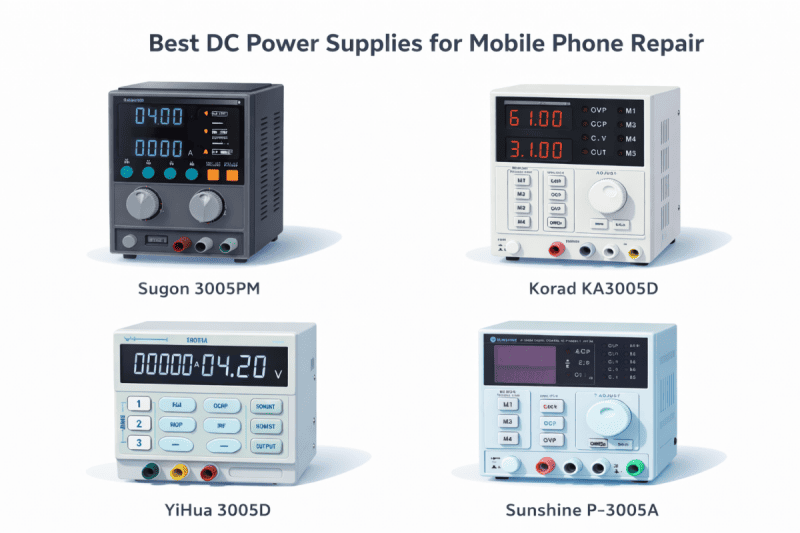
1. Sugon 3005PM
The Sugon 3005PM is widely used in professional mobile repair labs, especially for motherboard-level diagnostics.
Key strengths
- Extremely stable voltage output
- Fast response to current changes
- Clear digital display
Real-world use
Technicians often use this model to locate short circuits by observing sudden current spikes.
Pros
- High precision
- Reliable for long repair sessions
- Excellent build quality
Cons
- Higher price than beginner models
- May be excessive for basic repairs
Best for: Experienced technicians and advanced diagnostics
2. Korad KA3005D
Korad is known globally for laboratory-grade power supplies, and the KA3005D is a favorite among technicians who value accuracy.
Key strengths
- Very accurate voltage and current control
- Low electrical noise
- Memory presets for frequent settings
Real-world use
Helpful when testing different smartphones repeatedly with the same voltage and current settings.
Pros
- Precise readings
- Durable and reliable
- Professional-grade performance
Cons
- Slightly bulky
- Costs more than entry-level units
Best for: Repair shops and technicians who want lab-level accuracy
3. YiHua 3005D
The YiHua 3005D is popular because it balances price, features, and reliability.
Key strengths
- Easy to use
- Stable enough for daily repairs
- Good digital display clarity
Real-world use
Often used for powering Android phones during charging and power-on testing.
Pros
- Beginner-friendly
- Good value for money
- Widely available
Cons
- Not as refined as premium models
- Fan noise can be noticeable
Best for: Beginners and intermediate technicians
4. Sunshine P-3005A
Sunshine is well-known in the mobile repair community for affordable tools, and the P-3005A is no exception.
Key strengths
- Simple controls
- Budget-friendly
- Adequate stability for basic tasks
Real-world use
Common in small repair shops and training centers.
Pros
- Affordable
- Easy to operate
- Compact design
Cons
- Less accurate than premium models
- Not ideal for complex motherboard work
Best for: Beginners and budget-focused repair shops
5. Kada 3005D
The Kada 3005D is a straightforward DC power supply designed for learning and basic repair work.
Key strengths
- Simple interface
- Stable output for basic usage
- Lightweight design
Real-world use
Often used by students practicing mobile repair skills.
Pros
- Affordable
- Easy to understand
- Suitable for training
Cons
- Limited precision
- Not recommended for advanced diagnostics
Best for: Beginners and training environments
Comparison Table: Top DC Power Supply Machines
| Model | Voltage Range | Current Range | Best For | Skill Level |
|---|---|---|---|---|
| Sugon 3005PM | 0–30V | 0–5A | Professional repair | Advanced |
| Korad KA3005D | 0–30V | 0–5A | Precision work | Intermediate–Advanced |
| YiHua 3005D | 0–30V | 0–5A | Daily repair tasks | Beginner–Intermediate |
| Sunshine P-3005A | 0–30V | 0–5A | Budget workshops | Beginner |
| Kada 3005D | 0–30V | 0–5A | Training & basic repair | Beginner |
Common Mistakes to Avoid
Many beginners make these errors:
- Setting voltage too high
- Ignoring current limits
- Connecting power incorrectly
- Assuming all phones use the same power range
Even a good power supply cannot protect a phone if used incorrectly.
Practical Tips for Safe Use
- Always start with low current limits
- Match voltage to the phone’s battery rating
- Observe current behavior before increasing limits
- Use proper test cables and clips
- Power off before connecting or disconnecting
These habits prevent costly damage and build confidence.
Pros and Cons of Using a DC Power Supply
Pros
- Faster fault diagnosis
- Safer testing without batteries
- Clear visibility of power behavior
- Essential for motherboard repair
Cons
- Requires basic electrical understanding
- Poor-quality units can be risky
- Incorrect settings can cause damage
Frequently Asked Questions (FAQs)
1. What voltage should I use for mobile phone repair?
Most smartphones operate between 3.7V and 4.4V, depending on battery design.
2. Can a DC power supply damage a phone?
Yes, if voltage or current is set incorrectly. Proper settings are essential.
3. Is a DC power supply necessary for beginners?
It is highly recommended, especially for diagnosis and testing.
4. Can one DC power supply work for Android and iPhone?
Yes, as long as voltage and current are adjusted correctly.
5. How much current does a smartphone usually draw?
Normal idle current is low, but it increases during boot or charging.
6. Do I need an expensive model to start repairing phones?
No. A stable, basic model is enough for beginners.
Conclusion
A DC power supply machine is not just another tool—it is a core diagnostic device for mobile phone repair. From powering phones without batteries to detecting short circuits, it improves accuracy, safety, and efficiency.
✅ Quick Checklist Before Buying
✔ 0–30 V voltage range
✔ 5 A or more current capacity
✔ Digital display (voltage + current)
✔ OVP, OCP, SCP built-in
✔ Good build quality
✔ Fine control knobs
Beginners should focus on simplicity and stability, while experienced technicians benefit from precision and advanced control. The five models discussed here cover different needs, budgets, and skill levels, making it easier to choose with confidence.
With proper use and understanding, a good DC power supply can significantly improve repair quality and reduce unnecessary mistakes.