
Introduction
Smartphones have become essential tools for work, learning, communication, and entertainment. Yet, battery life remains one of the biggest pain points. Phones get faster and smarter every year, but many users still charge daily, worry about overheating, or carry power banks when traveling.
Lithium-ion batteries have powered smartphones for decades. They are reliable, affordable, and well understood. But they also have clear limits—safety risks, slow charging trade-offs, and gradual capacity loss.
This is where solid-state batteries enter the conversation. Often described as the “next big leap” in battery technology, they promise higher energy density, better safety, and longer life.
So the big question is: Will solid-state batteries replace lithium-ion in future smartphones?
In this article, we will explain everything clearly—from basic concepts to real-world challenges—so beginners and intermediate readers can understand what is realistic, what is hype, and what to expect in the coming years.
Understanding Smartphone Batteries
Before comparing technologies, it helps to understand what a smartphone battery actually does.
A phone battery:
- Stores electrical energy
- Supplies power to the processor, display, camera, and sensors
- Recharges repeatedly without major performance loss
What Is a Lithium-Ion Battery?
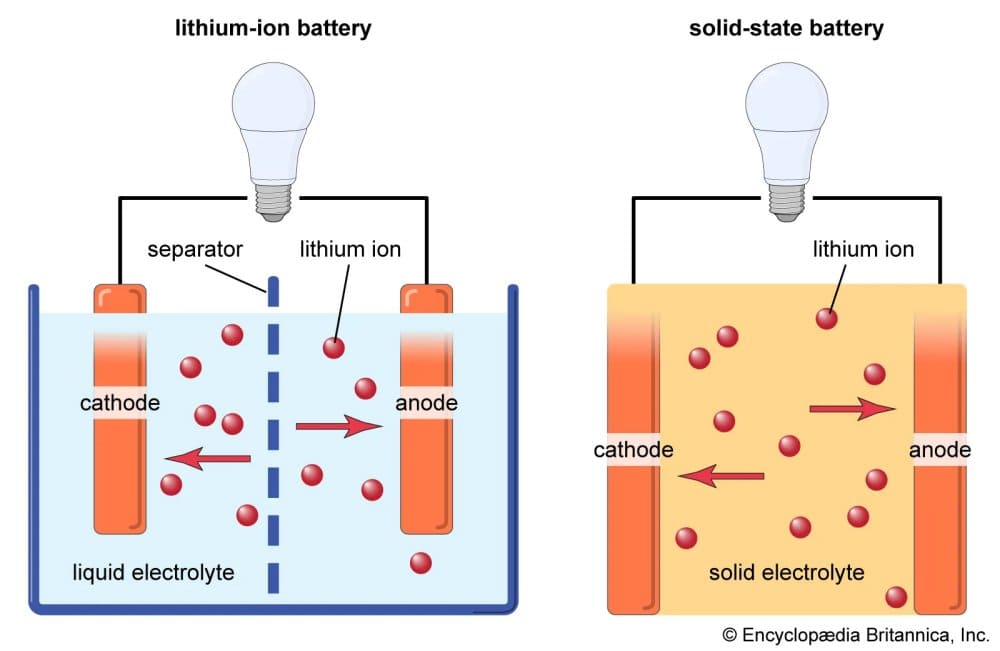
Lithium-ion (Li-ion) batteries use:
- A liquid electrolyte
- Lithium ions that move between the anode and cathode during charging and discharging
They are popular because they:
- Offer good energy density
- Are relatively lightweight
- Are cost-effective at large scale
But they also:
- Degrade over time
- Can overheat or swell
- Require protective circuits for safety
Note: Li-ion batteries contain a liquid electrolyte enclosed in a hard cylindrical or prismatic shell, offering excellent energy density.
Lithium-Polymer (Li-Po) batteries replace the liquid with a gel-based or solid polymer electrolyte and use a soft, flexible pouch, enabling slimmer and more compact designs and are costlier.
What Are Solid-State Batteries?
A solid-state battery replaces the liquid electrolyte with a solid electrolyte.
That one change has major consequences.
Key Difference in Simple Words
| Feature | Lithium-Ion | Solid-State |
|---|---|---|
| Electrolyte | Liquid | Solid |
| Leakage risk | Possible | Almost none |
| Fire risk | Exists | Much lower |
| Energy density | Moderate | Higher (theoretical) |
Because there is no flammable liquid, according to Android Central’s solid-state battery explainer they are inherently safer and can support denser battery designs.
Why the Smartphone Industry Is Interested
Battery innovation matters because smartphones are limited by:
- Slim designs
- Heat management
- User safety regulations
Solid-state batteries could help solve all three.
Potential Advantages
1. Better Safety
No liquid electrolyte means:
- Lower risk of fire
- Less chance of swelling
- Improved reliability under stress
2. Longer Battery Life
Solid electrolytes degrade more slowly, meaning:
- More charge cycles
- Slower capacity loss over years
3. Higher Energy Density
In theory, phones could:
- Last longer on a single charge
- Or become thinner without sacrificing battery life
4. Faster Charging (Eventually)
Some solid-state designs allow higher voltage tolerance, which could enable safer fast charging in the future.
This solid-state battery review points out that many prototypes can maintain over 90% of their capacity after thousands of cycles — far exceeding typical lithium-ion lifespans — offering a compelling case for future smartphone longevity. Such data helps readers appreciate the durability advantages solid-state cells could bring to mobile devices.
Why Lithium-Ion Still Dominates Smartphones
Despite the promise, lithium-ion batteries are not outdated.
Reasons They Are Still Used
- Mature manufacturing ecosystem
- Low production cost
- Well-understood performance
- Compatible with existing phone designs
Smartphone makers optimize lithium-ion batteries using:
- Better charging algorithms
- Adaptive power management
- Software-level battery health tools
For example:
- Android phones use AI-based charging control
- iPhones reduce charging speed near 100% to extend lifespan
Here are 10 charging habits that damage iPhone battery health faster.
These improvements help extend lithium-ion relevance.
Technical Challenges of Solid-State Batteries
This is where expectations meet reality.
1. Manufacturing Complexity
Solid-state batteries require:
- Extremely precise layering
- New materials not yet mass-produced
- Specialized equipment
Scaling from lab to millions of smartphones is very difficult.
2. Cost Barriers
Currently:
- Solid-state batteries are much more expensive
- Yield rates are low
- Quality consistency is a challenge
Smartphones are price-sensitive products, especially in India and emerging markets.
3. Temperature Sensitivity
Some solid electrolytes:
- Perform poorly in cold environments
- Lose efficiency at low temperatures
Phones must work reliably everywhere—from cold mountains to hot cities.
4. Durability at Small Sizes
Smartphone batteries are:
- Thin
- Flexible
- Subject to drops and vibration
Many solid-state designs struggle with micro-cracks over time.
Solid-State vs Lithium-Ion: Practical Comparison
| Aspect | Lithium-Ion | Solid-State |
|---|---|---|
| Market readiness | Very high | Early stage |
| Cost per unit | Low | High |
| Safety | Good (with protection) | Excellent |
| Battery life | Good | Potentially better |
| Repairability | Known | Unknown |
| Mass adoption | Global | Limited |
Will Solid-State Batteries Fully Replace Lithium-Ion?
Short Answer: Not immediately
Long Answer: Gradual, selective adoption
Experts widely expect a hybrid transition, not a sudden replacement.
Likely Timeline (Realistic View)
- 2026–2027:
Limited solid-state use in wearables, premium gadgets, or small batteries - 2027–2030:
Early smartphone adoption in flagship or experimental models - After 2030:
Broader adoption if manufacturing costs drop and durability improves
Lithium-ion batteries will continue to evolve alongside solid-state technology.
What This Means for Android and iPhone Users
For Android Phones
Android manufacturers often:
- Experiment earlier with new hardware
- Introduce innovations in flagship models first
We may see:
- Partial solid-state battery designs
- Hybrid batteries using solid electrolytes
For iPhones
Apple tends to:
- Adopt technologies only when they are mature
- Focus on long-term reliability
Solid-state batteries may appear later but with:
- Better optimization
- Strong ecosystem support
Either way, users should expect incremental improvements, not overnight miracles.
Common Myths and Misconceptions
Myth 1: Solid-state batteries will double battery life immediately
Reality: Gains will be gradual and model-specific.
Myth 2: Lithium-ion batteries are unsafe
Reality: Modern lithium-ion batteries are safe when properly designed.
Myth 3: Solid-state batteries will be cheap soon
Reality: Cost reduction takes many years.
Practical Takeaways for Smartphone Buyers
- Do not delay phone upgrades waiting for solid-state batteries
- Focus on:
- Battery capacity (mAh)
- Software optimization
- Charging habits
How to Extend Battery Life Today
- Avoid constant 0–100% charging
- Use slow charging overnight
- Keep phone cool during heavy use
- Replace battery after 2–3 years if needed
These habits matter more than battery chemistry right now.
Pros and Cons Summary
Solid-State Batteries
Pros
- Higher safety
- Longer lifespan potential
- Compact design possibilities
Cons
- High cost
- Limited availability
- Manufacturing challenges
Lithium-Ion Batteries
Pros
- Affordable
- Proven technology
- Easy to service and recycle
Cons
- Gradual degradation
- Thermal sensitivity
- Physical size limits
FAQs
1. Are solid-state batteries already used in smartphones?
No. They are mostly in research or limited prototypes, not mass-market phones.
2. Will solid-state batteries make phones thinner?
Potentially yes, but design choices will vary by brand.
3. Are solid-state batteries safer than lithium-ion?
Yes, especially regarding fire and leakage risks.
4. Will battery replacement become harder?
Possibly, depending on design and availability.
5. Can solid-state batteries charge faster?
In theory yes, but real-world fast charging depends on system design.
6. Will solid-state batteries be better for the environment?
They may reduce waste due to longer lifespan, but recycling systems are still developing.
7. Should I wait for solid-state battery phones?
No. Buy based on current needs and proven performance.
Conclusion
Solid-state batteries represent an important future direction for smartphone technology. They offer real advantages in safety, longevity, and energy density. However, they are not ready to fully replace lithium-ion batteries yet.
Lithium-ion batteries will remain the backbone of smartphones for several more years, improving steadily through better materials, smarter software, and optimized charging systems.
For users, the best approach is simple:
- Choose phones with good battery management
- Use healthy charging habits
- Stay informed, not hyped
Solid-state batteries are coming—but gradually, carefully, and selectively.