
Technology has been advancing at an incredible pace. Today, a single smartphone gives us access to entertainment, communication, productivity tools, academic resources, and creative apps. It has replaced dozens of devices we once used separately. Because of this, we carry our phones everywhere. But even with all these improvements, one problem continues to trouble users — battery life.
The more useful a smartphone becomes, the more we use it, and the faster its battery drains. This is why power banks have become a must-have accessory. A power bank acts like a portable energy backup that helps you keep your device alive throughout the day.
Even though smartphone brands try to offer larger batteries and improved efficiency, most users still struggle to get through a full day without charging. Bigger displays, high-refresh-rate screens, 5G usage, GPS, camera-heavy apps, and constant notifications all consume power rapidly.
Quick charging and software features like power-saving modes help to some extent, but they do not solve everything. For many people, a reliable power bank is the only practical solution.
You should also know how a powerbank works.
This power bank buying guide will help you understand what to look for and how to buy the best power bank for your mobile phone without confusion.
🟦 What You Must Know Before Choosing a Power Bank
1. Battery Capacity (mAh)
Capacity is the first thing people check. It is measured in milliampere-hours (mAh). The higher the number, the more charge cycles the power bank can provide.
A simple rule is:
Your power bank should always have at least twice the capacity of your phone battery.
For example:
- Phone battery: 5000mAh
- Ideal power bank: 10,000mAh or above
This accounts for natural energy loss that occurs during charging. If you want your phone to charge multiple times, go even higher — like 15,000mAh or 20,000mAh.
A 20,000 mAh power bank can charge a 5000mAh phone about four full times.
Important points about capacity:
- Very cheap power banks often inflate the mAh rating, so choose trusted brands.
- Larger capacity = heavier and bulkier.
- Smaller power banks (2000–5000mAh) are useful only for emergency top-ups, not full charges.
For travelers, gamers, vloggers, and remote workers, 20,000mAh or even 30,000mAh models are more practical.
Read: The 11 Best Battery Packs to Keep Your Gadgets Going
2. Manufacturer & Build Quality
The brand matters more than many people realise. A poorly built power bank can damage your smartphone permanently.
Trusted brands use quality batteries, stable circuits, and better protection layers. Unknown brands may cut corners to offer low prices.
Why brand matters:
- Better safety systems
- Accurate capacity ratings
- Long-lasting battery cells
- Stable performance
Power banks usually come with lithium-ion or lithium-polymer cells. Both work well, and the difference is minimal for regular users. What truly matters is the quality of manufacturing and the safety features.
Read A Brief history of powerbanks
3. Connectivity Options & Number of Output Ports
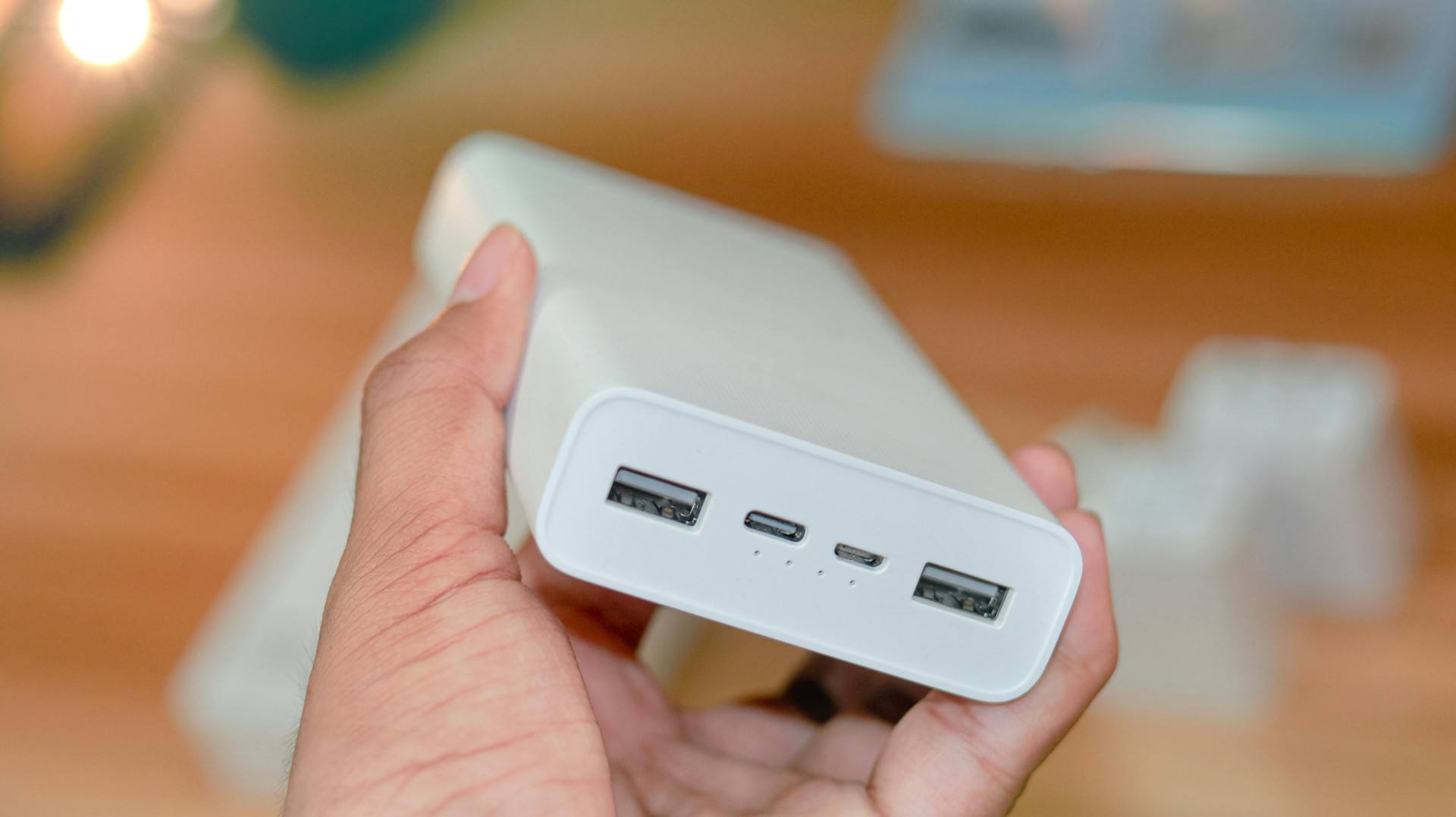
Power banks today support multiple output types:
- USB-A
- USB-C
- Micro-USB (older)
- Wireless charging pads
Having multiple ports allows you to charge different devices:
phones, tablets, smartwatches, Bluetooth earphones, portable speakers, and more.
Why ports matter:
- More ports = charge more devices at once.
- USB-C ports often support faster output.
- Some power banks offer bi-directional USB-C which allows both input and output.
If you switch phones (like Android to iPhone), multiple output options ensure your power bank remains useful.
Wireless charging power banks have also become popular, offering more convenience.
4. Input & Output Power (Fast Charging Support)
This is one of the most important parts of the power bank buying guide.
Input Power
Input power decides how fast the power bank itself charges.
Higher input = faster self-charging
Examples:
- 5V/1A → Very slow
- 5V/2A → Faster
- USB-C PD → Much faster
If you buy a high-capacity power bank (20,000mAh+), choose one with fast input to avoid waiting hours to recharge it.
Output Power
This is how fast the power bank charges your device.
Most phones today support fast charging:
- 10W
- 18W
- 22.5W
- 33W
- 45W
- 65W or higher for some brands
Choose a power bank that supports fast charging standards such as:
- Quick Charge (QC)
- Power Delivery (PD)
- SuperVOOC / Warp / Dash (brand-specific)
If you buy a slow-output power bank, your phone may take 2–3 hours longer to charge.
5. LED Indicators & Display Screen
Charging indicators are essential. They show:
- How much battery is left
- Whether fast charging is active
- Charging input status
Some premium power banks come with a digital display that shows the exact percentage. This is more accurate than LED dots.

6. Your Usage Pattern
Choosing the right power bank depends heavily on how you use your phone.
Heavy Users:
- Long travel
- Gaming
- Vlogging
- Instagram Reels, YouTube, editing apps
- 5G browsing
These users should consider 20,000mAh or 30,000mAh models with fast charging.
Light Users:
- Only need emergency battery backup
- Mostly near charging points
- Occasional trips
A 10,000mAh power bank is usually enough.
7. Quality and Safety Features
This is where you should never compromise. Cheap power banks may overheat, swell, or damage your device.
Look for these safety protections:
- Overcharge Protection
- Short Circuit Protection
- Overheat Protection
- Surge Protection
- Intelligent Power Management
- Certified battery cells

Good brands clearly mention safety layers. If specifications look vague, avoid the product.
8. Weight and Portability
Higher capacity means more weight. But new models now use improved lithium-polymer cells, making them lighter.
If you travel daily and prefer something light, choose a compact 10,000mAh model with USB-C.
If weight does not matter and you want all-day backup, go for a high-capacity model.
You may find power banks with more than 50,000 mAh, but they are very big and heavy. It’s better to avoid them unless you really need that much power.
9. Price & Value for Money
A high-quality power bank does not always mean expensive.
Before buying, compare:
- Capacity
- Build quality
- Charging speed
- Safety features
- Warranty
- Port options
Sometimes the same model is priced differently across online stores, so compare before buying.
Do not buy extremely cheap products—they often use recycled batteries and weak circuits.
10. Reviews & Real User Experience
Before buying, check reviews from people who have used the power bank for at least a few months. Early reviews can be misleading.
You can find helpful comments on:
- YouTube
- Amazon verified reviews
- Tech forums
Offline buyers can ask for feedback from people who purchased the same model. Real experience is always more reliable than advertising. If you want to buy electronic devices offline, alfa mobile store is also a good option.
🟦 New Points to Consider (Updated for Modern Power Banks)
11. Pass-Through Charging
Some power banks allow you to charge the power bank itself while it charges your phone.
Useful for travelers.
12. Smart Circuit Technology
Power banks now automatically detect your device’s required current and adjust output.
This protects battery health.
13. Solar Power Banks
Great for camping or areas without electricity.
Not very fast, but useful as emergency backups.
14. GaN Technology
New GaN-based power banks offer:
- Faster charging
- Better efficiency
- Smaller size
- Lower heat
These are becoming popular for users who want compact, high-speed charging.
Here are some best fast charging power banks under ₹1,500 in India which you can consider buying.
🟩 Conclusion: How to Buy the Best Power Bank
Choosing the best power bank depends on:
- Your usage needs
- Battery capacity
- Charging speed
- Brand quality
- Safety protections
- Port options
- Price vs. features
The right power bank makes your life easier, especially when traveling or working outdoors.
With the help of this power bank buying guide, you should now be able to choose the best option confidently.